
Building Wealth Starts With Strategy
Looking beyond the product for a smarter approach to wealth creation
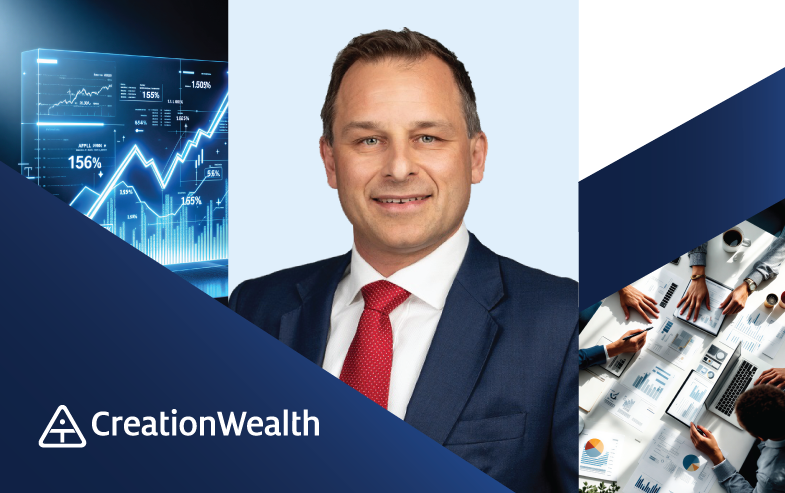
For Andrew Zbik, building wealth isn’t about finding the next product or following a one-size-fits-all formula. It starts with understanding where you are, where you want to go and developing the right strategy to get there.
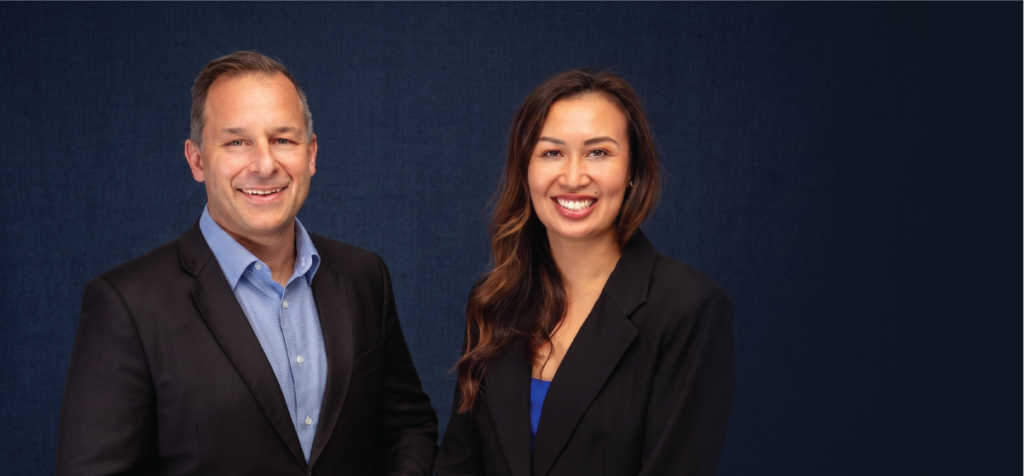
As Founder and Co-Director of CreationWealth, Andrew has spent almost two decades working alongside his business partner, Hoa, helping clients make smarter, more considered decisions about their financial future. With no commissions or products to sell, their advice is genuinely independent, allowing them to look across structures, strategies and asset classes to find what works best for each client.
In this month’s Spotlight Interview, Andrew shares the philosophy behind CreationWealth, the value of long-term client relationships and why the right strategy can make all the difference when it comes to creating wealth.
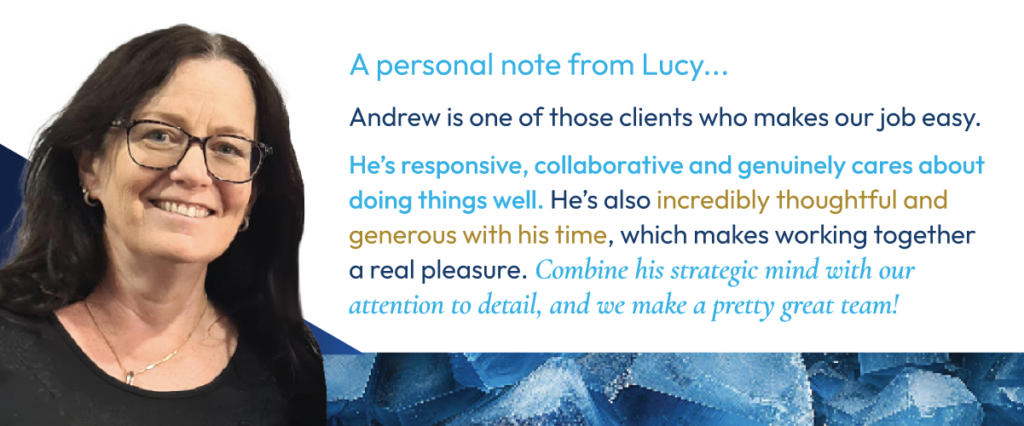
An intro from Lucy
We look after CreationWealth’s bank reconciliations, bill payments, BAS and general compliance, working closely with Andrew to keep everything running smoothly behind the scenes.
What really stands out about CreationWealth is the genuinely strategy-focused approach Andrew and Hoa take with their clients. Their advice is completely independent, with no commissions influencing the recommendations they make. They won’t recommend a product simply because there’s something in it for them. Their focus is on what is genuinely in their client’s best interests.
Andrew is our main contact, and he’s exactly the kind of client you love working with. He’s responsive, collaborative and always happy to provide what we need, which makes our job so much easier. It really feels like we’re working together to help him and the business succeed.


Tell us about your business and what you do.
CreationWealth is a strategy-focused financial advice business. My business partner, Hoa, and I have worked together for 19 years, so the business is really an extension of the client relationships, friendships and partnership we’ve built along the way. It feels like a natural continuation of what we’ve been doing together for almost two decades.
We don’t sell financial products or receive commissions. Our focus is simply on helping people create and grow wealth through the right strategy for their individual circumstances. That might involve investing in their own name, a self-managed super fund, an industry or retail super fund, a trust or a company. We’re completely agnostic when it comes to the underlying investments, which means we can genuinely consider all structures and asset classes and recommend what we believe is right for each client.
Is there a meaning behind your business name?
It’s very hard to come up with a name that hasn’t got a URL, is available to register as a business, and that you don’t have to spell out to everyone. CreationWealth was a 2 am brain moment, it felt like a very logical name to help people. Even our tagline, “Clarity, confidence, and creation” is what I’ve distilled fundamentally. We help to provide clarity on how you can, create wealth with confidence.
How did you get started in your industry?
I totally fell into it. I studied Business Administration and Law at university and ran a successful DJ business throughout UNI. As any self-respecting person who has a bit of an ego and a double degree would do, I thought ‘I’m not going to be a DJ anymore’. I finished my studies in Vienna, Austria and then I took a trip around the world.
After that, a gentleman I knew through The Rotary Club was looking for someone, so I landed back in Australia on a Monday and met him and his business partner on a Wednesday. His partner, who I respected a lot, asked if I’d ever thought about being a financial advisor which I’d never thought about. He said that my law background was a good skillset. He called me on the Friday and said “What do you think?” I said “It sounds really good” and he said “Alright, you start work Monday”.
What has your journey been like?
I’ve been very fortunate. Hoa, who is a great friend of mine and now my business partner, was there on my first day of work on that Monday. They didn’t tell her I was starting so I told her I was a new employee, she’d went to take a phone call and came back with a stack of filing for me to do.
My career is quite unique in the sense that for someone my age to have done the same thing for 19 years is pretty rare, and to have had a friend like Hoa that wherever I’ve moved she’s followed. I’ve been with 3 different firms in my time, but CreationWealth is truly our own firm. We both take a lot of pride in the fact that we have clients today who started with us in 2007. That really means a lot to me.
What has been your favourite part of the journey?
I love the relationships. I call this finance with personality. I like the thinking, the strategy and the complexity. Something I’m good at is taking complex ideas and explaining them in clear terms for clients. The relationships is what I enjoy – sitting down and talking with people. We genuinely do change lives. We have a lot of clients we’ve been working with for 13 – 15 years now and we can see they’re retiring 5 – 7 years earlier because of the strategies we’ve put in place. That’s really meaningful to have been around that long and see real change for people.
What is it like working with a business partner and how do you define your roles?
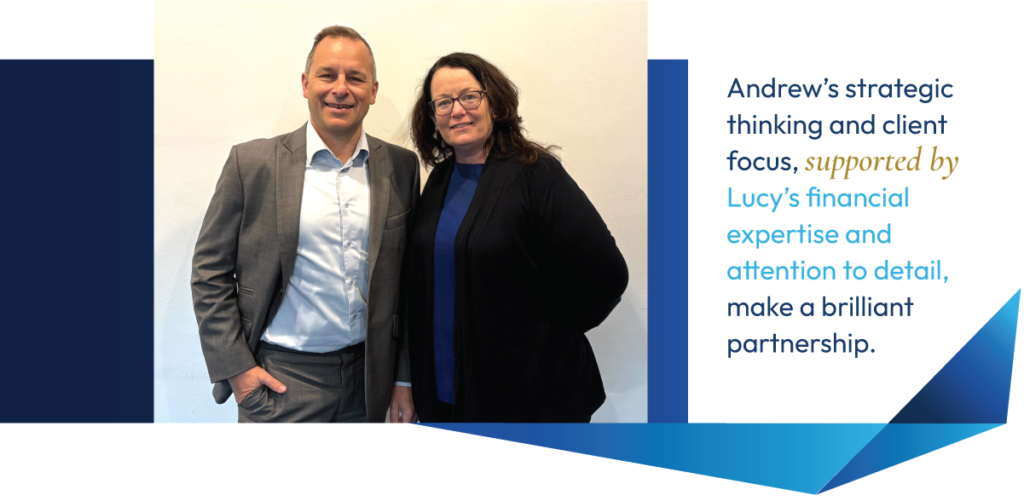
We’ve actually been together longer than we have with our respective marriage partners. We’re really good friends with a lot of mutual respect, and in a business sense we complement each other’s strengths and weaknesses. You’re not a client of Andrew or Hoa, you’re a client of the firm and both of us look after you.
We have previously used a business coach and it’s quite interesting having someone external come in and say “This is why you work together so well”. It’s really a luxury that we can always be playing to our respective strengths, and each partner’s weekness is naturally covered by the other’s strength. It’s a nice yin-yang that helps us cover all bases.
For a lot of clients that are couples too, it’s nice to have a male and female advising, particularly for women. We get lot of feedback that people feel like other male advisors speak down to them or only speak to the male partner. Between Hoa and I, we have that essential male-female combo and a lot of our clients love that.
Do you find that one’s more the visionary and the other one’s more the implementer?
Always – you’ve always got the dreamer and the doer. You’ve always got the one who knows the numbers and the one who doesn’t know which way a dollar sign goes up. I think it’s classic in so many relationships that opposites attract.
For you and Hoa, who’s the visionary and who’s the implementer?
I’d say I’m the visionary and Hoa’s the implementer. She grounds me because I can dream too much but I bring Hoa along to try some new things. I really appreciate having a business partner who, in a very kind way, will go, “Andrew, that’s just not a priority right now. This is what we need to focus on”. At the same time, I drive innovation. She knows I’ll go off and experiment with something and then come back with the idea.
A great example would be the integration of AI into our business and how we use it. I played around with a few solutions and found something that worked. Then Hoa had the confidence of knowing when I presented something that I’d already tested it. That’s where we complement each other well.
How would you describe your leadership style and how does it influence your team?
I’m naturally a very collaborative leader, I like explaining the “why”, so the team understands why we’re doing what we’re doing. I like the idea of building a team, giving them the vision, then trusting them to deliver it. I think it’s important not to micro-manage, I empower each individual to figure out what works for them.
One of our newest team members is coming up with a few new ideas as they have fresh eyes, but it’s also just what’s working for them. The fact that I’m willing to amend these processes makes it easier for them and how they serve our clients. It’s a real two-way street, the business needs processes but the individuals need processes that work for them too.
What makes your company stand out in the market?
We’re truly free of commissions. Ironically, there are platforms out there where we cannot switch off the commissions, so what we’ll do is receive those and rebate it to our clients. Clients have that peace of mind, whether you buy an investment property, a share, or set up a fund, we are paid the same and that’s the integrity of our process.
Not everyone needs a financial advisor, we live in a world where if you wanted to spend long enough on google you can find your answers but whether they’re going to be right for you is the skills, expertise, and experience we bring. Everyone naturally builds experience over time with investing, but we bring discipline. With every client we’ve preschedule the next review, it’s an accountability point.
Between May to June, we completed a 15-minute zoom with every single client, which we do every year to explain the pertinent aspects of the budget, and what’s relevant to them. The clients really value that, and I think about 30% of the time we’re sitting down and telling them there’s nothing for them to do – it’s peace of mind for them that we have that discipline. We’re checking everything, and giving proactive advice. It sets us apart to have that structure in how we engage with our clients.
Please share a little a little about your purpose, and aspirations for the business.
Hoa and I enjoy being advisers, we enjoy advising clients, and we’ve deliberately chosen the type of business we want to build. When Dixons Advisory collapsed, I realised there are so many people who are trying to scale advice.
Financial advice has been an industry that’s evolved into a profession, a very young profession. Truly as of the of January 1 this year you can call it a profession, you must have a relevant tertiary degree now to be an advisor and be fully licensed. We’re now on par with an accountant or lawyer in terms of the professional journey you need to take.
I would’ve always thought of it as a profession.
I guess I’m pretty unique, I’ve been admitted as a solicitor, so I’ve done the College of Law, I did have a real estate certificate and I make few jokes about that one. Then I did the RG146 to become an advisor. Financial advice is now a proper profession with proper qualifications to practice. There’s a reason why there used to be 24,000 advisors and there’s roughly only 15,000 now.

How would you describe your core values?
Loyalty, honesty, responsibility. We were talking in our team meeting this morning about one personal rule we’ll never break, and I said mine was “Honesty is the best policy.”. I learnt from the gentlemen I first started working with, that when you make a mistake, to own it. Take responsibility, explain to the client a mistake was made and how we’re fixing it. Clients trust us because they know we’ll be honest and it does wonders to build trust. The clients that are the biggest advocates are the ones where something went wrong at some point, but because we owned it and took responsibility, is why they refer to us.
What drives you every day? What feels most important about the service you provide?
I love what my dad once said to me, “Your mission in life is to leave the world in a better place”. I’ve tried that in a few different spheres in my life but as I said earlier, we change peoples’ lives in this role. I like the approach of being proactive and strategic. The enjoyment of working with people is what motivates me to keep being an advisor, despite all the compliance that drives me crazy. Every time I have a meeting with a client, it’s just a buzz. I love it.
How has compliance changed over the last few years for your profession?
The best statistic I have is, in 2018, I individually was looking after 120 households with one support staff. Hoa and I right now have 115 households between the two of us, with 3 support staff and possibly a fourth soon.
Looking back 10 years ago, a statement of advice was 30 pages, I issued one on Friday that was 110 pages, but the substantive advice has not changed. Obviously, there are reasons this was introduced. The Banking Royal Commission did unearth a lot of bad practices, but it’s a pendulum. A client gives me 10-minute phone call, I can work out the substantive strategy in 20 minutes but then we spend 3 hours doing the paperwork. We have to do it, it just means we’re working 60 hour weeks at the moment to get it all done.
The sad thing is the cost of advice has almost doubled to quadrupled across the industry; there are a lot of people who need advice and just can’t afford it. When I first started, it was the domain of high-net-worth individuals, then I’d say in 2012 – 2014 we were seeing almost everyone could get access to advice. Now we’re seeing it go back up, high income earning individuals can afford advice, but for low-income earners, it’s just out of reach.
What feels most important about the service you provide?
That’s it’s personal and customised. We know which clients of ours like detail so we provide detail. We know which clients like things at a high level so we do that. A lot of our onboarding process focuses on their values and what drives them, to help us understand them as people. We kind of work out with the client, what they know, and what they don’t you know. That’s where my job comes in – to provide a the custom knowledge to build up their understanding before we start talking strategy to help them better understand it. When I start using terms like non-conceptional contributions and things like that, they’ve got some background on what it means.
Describe what challenges have you faced along the way, and how you have overcome them.
I think the compliance regime, just that it takes us longer to do the same thing. AI has helped to some degree with that, but we’re finding now it’s more non-financial compliance. Anyone who’s in accounting or legal now understands the AUSTRAC regime, which us financial advisors have been operating under since 2008.
Cybersecurity also – data feeds were such a time saver – now they’re just a timewaster. I’m laughing now because I’m seriously thinking of going back to asking clients to send us a CSV file due to all of the data security concerns around getting data feeds from banks. Something that was creating such efficiencies 10 years ago, is now creating huge time wastage because data feeds just aren’t working anymore.
What data feeds are not working for you?
From all your retail banks, we’ve got a great software program that will get a data feed of all transaction history, but every bank’s got a different protocol. They time out now every 12 months, clients aren’t good at keeping on top and we can’t reactivate the data feeds so it has to be client-driven, now with two-factor authentication, with higher certification standards. People are saying it’s too hard, so we’re not getting the data anymore and that causes delays. Challenges like that where I think it’s funny how things come full circle.
What advice would you give to others looking to solve similar challenges?
I’ve always adopted the mindset that evolution is constant, changes are a given. It’d be so nice if things stayed constant, but when I came to the realization that that’s not going to happen and accepted change as a constant, it changed my mindset. When I talk about our processes within the business, we’re constantly evolving them, constantly updating them.
That’s why I’m so relaxed with changes in AI, people have been scared of it, but I’d say, it’s just another change, it’s another reiteration. Over the last three years, I’ve used seven or eight different AI programs, it’s that ability to be flexible and nimble and do it quickly. That’s sort of my mantra, and that’s why I feel we’re evolving as a business because it’s just a constant, that’s our normal.
What innovations in your industry are you most excited about?
I think AI has the potential to free up the compliance and get us back to advising, we get compliance tasks thrown on us all the time. I’m excited by AI, in my career, I used to see 12 clients a week and then it was 10 clients a week and then it was 8, and now currently I can see 6 clients a week. The workload to prepare before and after has expanded, I’d love to see AI just take away the compliance side. I provide the most value when I can pick up the phone and speak with the client. AI can enable more face-to-face time and that’s what people value.
What’s the best piece of feedback you’ve ever received from a customer?
Just thank you for being honest. They trust me that I will tell the truth. And that’s why they’re at ease being a client of our firm.
How do you define success for your business?
Our business has one key measure to show that we are successful, our clients have to explicitly opt in every 12 months to continue with our service. We’re running at an approximately 98-99% renewal rate. To me, that is a good measure of success. Maybe I’m not charging enough, maybe I’m over servicing, but I think obviously our clients see value in what we do.
Our team doesn’t live to work, we work to live. We have that balance, acknowledging that we’ve all got lives beyond this business. If we can create a culture and an environment where they come to work and enjoy what they do and they feel they’re making a difference, that’s a great business and that’s what we’ve fostered in our team.
Is there anything else you would like to include?
If you don’t have a financial advisor, a discovery meeting is free of charge, so come and find out how it works. If you look at anyone who’s high performing, they have a coach. I often use the analogy: think of us as a coach – we’re the chief financial officer of your household. That’s what I see our role as, and we help to make sure that you’re on top of your game, how you’re building your wealth and managing your household finances, and that you’re not missing out on anything.




We’d love to ask you a few questions about your experience with Blue Amber…
What were you looking for in a bookkeeping service?
Someone who’s on time and actually keeps us on our toes. The credit to the Blue Amber Bookkeeping team is: I know I’ve got things I need to do for you guys, and that’s because you are doing your job of following us up. In fact, it’s my new financial year resolution, to have an hour every Tuesday blocked out in my diary for it. I’ve realised I actually have to dedicate an hour every week to put aside for bookkeeping. Even though I’ve always thought I’ve outsourced it, clearly I need to prioritize from my end, time to respond to your team. You guys have driven a shift in what I need to do and it’s for the better of my business.
What made you choose Blue Amber?
The ISO standards, knowing that you yourself have prioritised investing in systems and processes and seeing that proactivity. You were not the cheapest, but you’re getting things done, which is what we needed. Those non-core tasks for us that will help us with monitoring our cash flow and getting you guys as the professionals to do that for us. It’s much better for me to pay your team to do it properly as opposed to me spending three hours fiddling around with it. As I said, it’s incumbent on me at the moment, but we’ll get better.
How would you describe the value of our product/service?
There’s a whole list of functions that you can help us with. I’m not on monthly BAS because you get our BAS in on time every quarter, and being on top of the ball for things like Payday Super. Having those systems and processes in place. In fact we’re thinking of expanding our service to get Blue Amber to help with managing the processing of client fees. It’s things like that which frees us to do what we do best – sitting in front of clients and giving quality advice.
How have we helped you be more successful in your business?
I’m very lucky in the sense that our business is very stable. Most of our clients are on retainer, most of our costs are fixed, so we have very little variability in our cash flow. So, mainly, it’s that forward planning piece. All our previous bookkeepers have been reactive, whereas we’re currently putting in things in place together that change it from reactive to proactive and it helps us strategize with what we do as a business, so that’s a huge positive.